What is the most expensive street in Wimbledon?
Copse Hill is the clearest answer in the 2026 published ranking checked for this article, while Parkside is the famous historical answer. Rightmove's March 2026 Most Expensive Streets report names Copse Hill, SW20, as Merton's highest-priced qualifying street, with an average asking price of £2,631,250. That is a specific finding about advertised homes in a defined sample, not a valuation of every property in Wimbledon.
Parkside, beside Wimbledon Common, has a much longer association with exceptional property prices. Older national coverage named it Britain's most expensive residential street. The distinction matters: a historical headline, a current asking-price survey and a completed-sale analysis can produce different answers without any of them measuring exactly the same thing.
For buyers, the useful question is therefore twofold: which road leads a particular ranking, and which property offers the right combination of setting, space and value? This guide explains the evidence, the streets worth understanding and the checks that matter when buying at the upper end of Wimbledon's market.
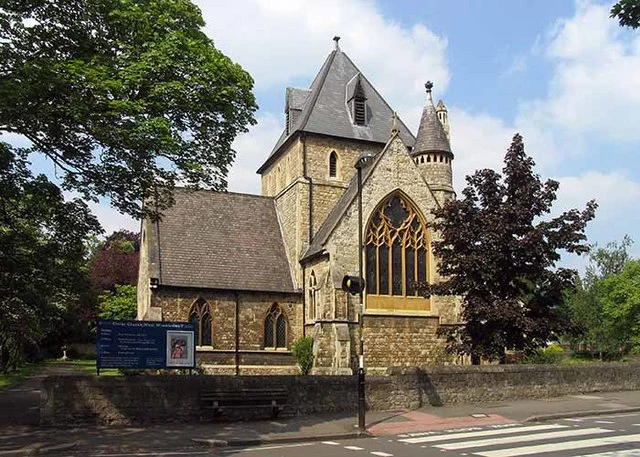
The house photographs are illustrative, not properties offered for sale or evidence of street prices. The Christ Church photograph is credited below.
The 2026 evidence: Copse Hill leads a qualifying asking-price table
Rightmove's report, published on 9 March 2026, includes a London local-authority table. Its entry for Merton is Copse Hill, SW20, at £2,631,250. Copse Hill is in West Wimbledon, so it is relevant to a Wimbledon search even though it is outside the SW19 postcode that many people first associate with the area.
The methodology is important. The report includes streets where at least five homes were available for sale during January 2026. Its figures are average asking prices, rather than the prices buyers ultimately paid. Streets with fewer qualifying listings can be absent, however expensive their individual houses may be.
That makes Copse Hill a properly sourced answer within the report's rules. It does not prove that it contains Wimbledon's most valuable individual house, or that its completed-sale average exceeds every other road's over every period. Those would require separate evidence and a clearly defined comparison.
Why Parkside is so often given as the answer
Parkside's reputation is not invented. A Luxuo article dated 3 January 2011 reported it as the country's most expensive residential street, with an average property price of £5,058,000. It is useful evidence of how long the road has been associated with the top end of the market, but it is emphatically not a current 2026 price guide.
The local connection is more recent too. In November 2024, The Wimble asked estate agents about desirable Wimbledon roads, and Parkside was one of the choices. That was a discussion of preference and desirability, not a statistical ranking of completed sales.
Parkside therefore remains an important name to understand when exploring prime Wimbledon. The mistake is to copy an old “most expensive” label into a new article without retaining its date. A road can have a strong luxury-market reputation while a newer survey, using different rules, names somewhere else.
Why these streets attract attention
At the expensive end of a residential market, buyers are often comparing more than bedroom counts. Plot size, usable garden space, the relationship between neighbouring buildings, architectural character and the quality of the setting can materially change a property's appeal.
In Wimbledon, proximity to the Common and Village is part of that conversation. A substantial house near open space offers a different experience from a similarly sized home in a more intensely built-up position. Neither is automatically better: the buyer may place greater value on a station walk, a level approach or nearby services.
Those qualities explain why location needs to be assessed carefully, but they do not justify applying a fixed premium to every address. A house facing a busy road, a property needing extensive work and a comprehensively renovated home can occupy the same street while presenting very different buying propositions.
Copse Hill: look at the individual property, not just the headline
The 2026 ranking gives buyers a reason to investigate Copse Hill, rather than a reason to bypass normal judgement. An average derived from advertised homes is a description of the sample. It is not the minimum budget needed to buy anywhere on the road, or a guarantee that every listing is appropriately priced.
Compare the size and type of the homes behind an asking price. Check whether the accommodation is mostly in the principal house, whether additional spaces are genuinely useful, and how much outdoor space is private and accessible. The same nominal floor area can work very differently across two properties.
Also test the location in person. West Wimbledon should be considered on its own practical merits, including the routes you would use for work, shopping and leisure. A prestigious description is much more meaningful when the home supports your ordinary week.
Parkside and the Common: reputation with practical considerations
Parkside's relationship with Wimbledon Common helps explain its prominence in discussions of the area's most prestigious addresses. The opportunity to live beside substantial open space can be a strong attraction for people who want outdoor time to form part of daily life.
That setting should still be evaluated from the exact property. Consider the outlook from the rooms you actually use, the position of garden boundaries, traffic at different times and the route to public access points. A map showing green space nearby cannot answer all those questions.
If atmosphere is an important part of your search, our guide to the nicest parts of Wimbledon explores the Village, Common and other neighbourhoods. The most attractive setting for one household is not necessarily the most convenient or suitable for another.
Southside Common and other names to keep in perspective
Southside Common also appears in discussions of exceptional Wimbledon homes. The Wimble's November 2024 feature described a seven-bedroom period property there being marketed at £14 million. That is a dated example of an individual asking price, not proof of the eventual sale price or the average value of the street.
The same feature's contributors mentioned other desirable roads, including Highbury Road and Vineyard Hill. This is useful local context because it shows that desirability is not limited to one address. It is not a numerical league table, and should not be presented as one.
For a buyer, these names can help frame a search. They should not replace a shortlist based on suitable homes. An expensive outlier, an attractive road and a strong street-wide average are three different observations, each requiring its own explanation.
Asking prices and completed prices answer different questions
An asking price records the seller's advertised position. A completed price records an agreed transaction that has proceeded to completion and, where applicable, registration. The two figures may be close, but one should never be silently substituted for the other.
Rightmove's 2026 report is useful for understanding the advertised market covered by its sample. Completed transactions are a different source of evidence when assessing an individual purchase. Buyers are better served by understanding both than by selecting whichever figure makes a street sound most impressive.
For a transparent starting point, HM Land Registry's free Price Paid Data gives the public access to registered sale-price information in England and Wales. This is a valuable resource for evidence-led property research. The department explains its coverage, updates and limitations, including the fact that very recent information may not yet be complete.
How a handful of sales can change a street ranking
Luxury-property markets can have relatively few transactions on an individual road. If the homes that sell in one period are unusually large, the average can rise even without evidence that every property has increased in value. A different mixture of sales can produce the opposite effect.
A simple hypothetical example illustrates the point. If two houses sell for £3 million and £9 million, their arithmetic mean is £6 million. That does not establish that a third, substantially different house is worth £6 million. The number describes those two transactions, not the entire street.
Always ask about the dates, sample size, property types and calculation. A median, mean and highest recorded transaction measure different things. Comparisons become especially unreliable when one road is represented by a short recent period and another by a much longer history.
How to judge value when buying an expensive Wimbledon home
Begin with comparable properties rather than a street-wide headline. Relevant evidence should take account of size, condition, plot, tenure, position and timing. An agent's explanation should make clear why a comparable is useful and where it differs, not simply point to the highest nearby figure.
Inspect practical matters that can be costly to change: layout, roof condition, access, drainage, heating and the relationship between indoor and outdoor space. A high purchase price does not make a survey unnecessary. Nor should impressive presentation substitute for understanding the condition of the building.
Our guide to buying a home in Wimbledon considers the wider decision. Budget for the transaction and ownership as well as the purchase itself, and take appropriate independent legal, survey and financial advice. Prestige is not protection against unexpected expenditure.
Does an expensive street guarantee the best lifestyle?
No. A household may prefer a shorter journey, a more manageable property or a location that leaves greater flexibility in the budget. The road with the strongest price reputation is not automatically the place that offers the best everyday experience.
Visit at different times and walk your actual routes. If you expect to use the station frequently, test the journey rather than relying on a broad Wimbledon label. If privacy matters, look at sightlines and neighbouring development rather than assuming a large garden solves everything.
Consider maintenance as part of lifestyle too. More space can be a pleasure, but it can also require more time, energy and expenditure. The right home is one whose advantages you will genuinely use and whose obligations you can comfortably manage.
What should sellers take from the rankings?
A recognised street name can support an introduction to a property, but a persuasive valuation needs evidence specific to that home. A seller should ask how current competition, completed comparables, condition and presentation have informed the recommended asking price.
A historic national headline is not enough to establish today's value. Equally, absence from a particular table does not prove that a road has lost its appeal: it may simply fail the survey's sample requirements. The strongest marketing explains the property's real benefits accurately rather than trying to inherit an unrelated statistic.
Buyers and sellers ultimately benefit from the same discipline: explain the evidence, identify its limits and keep the property's individual qualities in view.
The answer, with the evidence kept clear
For the 2026 Rightmove ranking examined here, Copse Hill is Merton's highest-priced qualifying street by average asking price, at £2,631,250. For Wimbledon's historical luxury-market reputation, Parkside is the name behind the older “most expensive street” headlines. Neither statement establishes a definitive, all-property completed-sale ranking for Wimbledon in October 2026.
Both are useful starting points for understanding the area's upper-end market. The sensible next step is to compare real homes, their settings and relevant evidence, rather than assume that a single street name settles the buying decision.
Research note: Sources checked: Rightmove, Britain's Most Expensive Streets Revealed 2026 (9 March 2026; January asking-price sample, minimum five homes); Luxuo (3 January 2011; historical Parkside report); The Wimble (21 November 2024; desirability interviews and a historical listing); and HM Land Registry's Price Paid Data guidance. Asking prices are not completed prices. No independent all-street transaction ranking was calculated for this article.
For advice on comparing Wimbledon homes and understanding their position in the local market, speak to your wimbledon estate agent.
Share this article